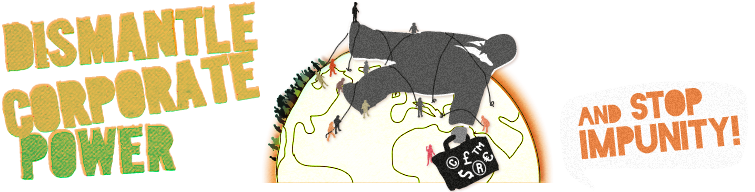
A few Transnational Corporations (TNCs) control 40% of the global economy. TNCs have a long track record of corporate abuses, what we call economic and ecological crimes. Bilateral Investment treaties and investment chapters in the Free Trade Agreements (FTAs) are part of an architecture of impunity for transnational corporations (TNCs) and as such undermine the sovereignty of both developed and developing countries, democratic governance and peoples’ interests. It allows corporations to challenge national laws that go against TNCs profit expectations.TNCs are known to have overturned laws and national policies including regulations to protect public services, the environment, working conditions, labour standards and health.
All over the world citizens are developing new forms of solidarity and taking new levels of resistance struggles against the domination of corporations.
We call on the governments of Asia and Europe to put the interests of people before corporate profit and greed. We demand the immediate halt of negotiations for new investment agreements: BITs and FTAs, and the termination of existing ones. We recommend governments that do not have the chance to terminate the agreements, to re-negotiate them and exclude investor-state dispute settlement mechanism. We demand governments to end corporate impunity and impose binding obligations on corporations related to human, economic, environmental, labour and social rights.
SYNTHESIS INVESTMENT WORKSHOP
Quote of the day: “A silent coup d’etat is taking place now because of corporate power”
- Transnational Corporations (TNCs) have become very powerful, integrated 1%
- TNCs have taken over all major aspects of the national economies: public services, natural resources (mining, oil extraction) and threatens farmers and workers livelihood as well as food sovereignty and decent work.
- TNCs are committing economic and ecological crimes and there are no mechanisms to hold them to account
- FTAs & investment treaties provide an architecture of impunity that legitimises TNCs abuses / Bilateral Investment Agreements subordinate the political prerogative of states to transnational corporations
- Through Bilateral Investment Treaties in effect a new ‘constitution’ for our countries is being composed by bureaucrats and corporations
- Investment treaties allow corporations to challenge national laws that go against TNCs profit expectations. TNCs are known to have overturned laws and national policies including regulations to protect public services, the environment, working conditions, labour standards, health
The impacts of TNCs abuses can be felt in different countries in Asia and Europe:
- In the Philippines the Mindoro Nickel Project owned by Norwegian mining company, INTEX RESOURCES is contaminating a major water source. A liberalised investment policy is being pursued at the expense of people’s rights over their resources, and of the ecological integrity of the island province, while also threatening food security.
- Indonesia is a main target for foreign investment: 93 % of total land teritory is under the control of big companies in the areas of mineral and coal mining, oil and gas, forestry, oil palm plantation.
Investment in Indonesia is dominated by foreign companies: 95% of mineral investment is made by two US companies (Freeport McMoran and Newmont Corporation). 85% oil and gas exploitation, 48% of oil and gas (Chevron and Exxon Mobile), 75-80% of coal exploitation, 65% of plantation, and 65% of banking industry are controlled by foreign companies.
Indonesia has been liberalising investment and increasing protection of investors: Government has signed FTAs and various BITs. Using investor-state dispute settlement, corporations have been suing Indonesia (Churchill company and Karaha Bodas Corporation (KBC), resulting in Indonesia having to pay out 261 million USD of public money.
- In Malaysia, TNCs have taken to actively sacking workers standing up for their rights and are suing human rights defenders, including community leaders, standing up for them, as well as media highlighting their plight. Migrant workers are particularly affected: wrongful termination means a retraction of their work permit and deportation, closing all their avenues for legal redress.
- In Europe: In an increasingly globalising world, Europe is increasingly not just a source, but also a receptor of FDI and under an increasing threat of investment arbitration cases. Energy corporation Vattenfall is currently suing the state of Germany for at least 700 million Euros over the German decision to phase out nuclear energy by 2022. Such sums exert significant pressure even on the public budget of large developed states like Germany and the threat of investment arbitration hampers policy avenues out of the crisis
- The fact that Philip Morris has been able to sue Uruguay and Australia at international court is a direct assault on government’s attempts to protect public health.
ACTIONS/CAMPAIGNING
There are 2 current campaigns (Global campaign against TNCs, EU-ASEAN FTA campaign) where these issues are being addressed and people can join. Some concrete proposals to take up in the context of current campaigns:
* TNCs have proved sensitive to social pressure. Proposal to have joint European and Asian civil society cross-solidarity when European corporations that are violating rights and using their powers to disregard regulations and welfare of people and the environment in Asia. One of those that we can start to work together on is the case of Churchill Mine against Indonesia.
* Strengthen the calls to our own governments to terminate existing agreements and pledge to not sign new ones. As a second best option, demand that our governments exclude the investor-state dispute settlement process from their investment agreements.
* Strengthen campaign outreach: reach out to (temporary) workers locally, nationally and transnationally, reach out to communities affected by incoming investment.
* Organising Asia-Europe worker and trade union solidarity campaigns targeting TNCs/international brands for human rights violations in their production chains. Online campaign and creative branding of the campaign (ex. Lipton Tea = Casualtea, your rights are sure to be violated)
* Develop cross-regionally proposals for alternatives to the current trade and investment model and for binding obligations for corporations
* Build common agenda and common actions in Asia and Europe (once a month name and shame campaign against corporations).
* CSOs should continue to lobby, through the AEPF, the rejection of the ASEAN Minerals Cooperation Plan and the EU Raw Materials List.
TOOLS FOR ACTION (to be developed)
A first step of overriding importance is to coordinate the sharing of information and making effective use of platforms for strategising. There are several tools that we can use to strengthen Asia-Europe coordination and common work on these issues:
E-lists:
alternative-investment-model@lists.riseup.net
tnc-etns-global@lists.riseup.net
To subscribe, you can write to Joseph Purugganan josephp@focusweb.org and Cecilia Olivet ceciliaolivet@tni.org

